


Paul Warburg Shows He Understands That Power Is the Ability to Do Harm over Time
- john raymond
- Oct 16, 2025
- 3 min read

A Prefatory Aside: Belarus Is Cooked. Let us dispense with preliminaries. Readers of my prior work will know that I have already written at length that the war in Ukraine will not end until Belarus—the last satellite holding Putin’s western flank together—surrenders, either politically or militarily, to the Ukrainians.
Paul Warburg, to his credit, arrives at the same destination. He may differ in route, but his conclusion is identical: Belarus is cooked. The regime sits in an existential bind, dependent on a collapsing patron and trapped by the very alignment that once promised survival. On that endpoint, he and I are in full agreement.
The Real Subject: Power and Harm. What makes Warburg’s recent video exceptional is not his map of the collapsing Russian empire—others can draw that—but his almost throwaway insight at the twelve-minute mark: “Russia is still losing power with each passing year of the war … Russia will not be able to do as much harm to our children as it has done to us.”
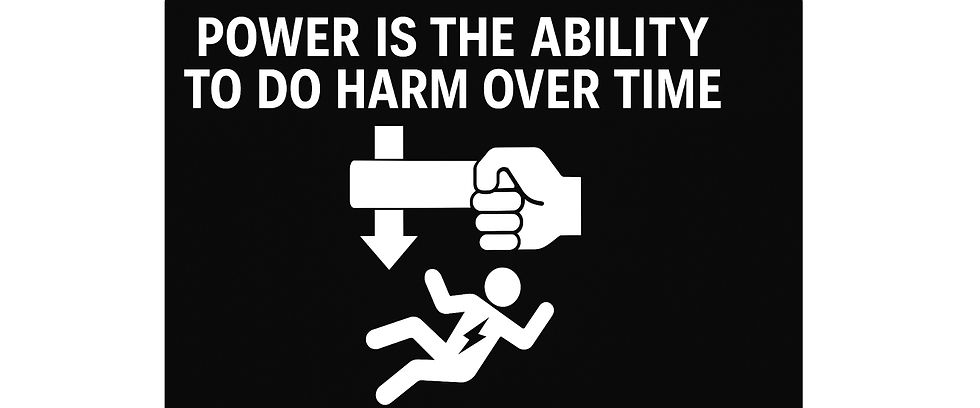
Most commentators would let that line drift by. They shouldn’t. In that sentence Warburg demonstrates that he understands what most geopolitical analysts, think-tankers, and pundits still do not: power is the ability to do harm over time.
The Power Equation. Formally stated,
This is the first principle of regime mechanics. It quantifies what regimes feel intuitively—how much damage they can inflict, and how quickly. Power increases when harm can be done faster; it declines when harm either diminishes or takes longer to deliver. All other measures—GDP, divisions, nuclear stockpiles—are secondary. They are inputs into harm; time is the denominator that converts capacity into usable power.
Warburg’s phrasing recognizes that the Russian state is bleeding from both sides of the equation. Its harm capability (H) is contracting under material attrition, and its time constant (T) is expanding as everything—from supply lines to propaganda cycles—takes longer to translate into effect. Thus its real power curve is collapsing exponentially.
Why Most Analysts Miss It. Most people who discuss “power” talk about it in context: relative GDPs, troop counts, or diplomatic influence. They do not talk about it in physics.
They describe position, not velocity. That is why their forecasts fail. They treat power as a thing possessed, rather than as a rate of harm delivered through time. A state’s stored destructive capacity matters little if it cannot act fast enough to impose its will before the environment adapts.
Warburg, by contrast, speaks in time derivatives. He grasps that Russia’s empire is losing its temporal leverage—that the rate at which it can convert resources into coercive outcomes is slowing. This is why his insight is not merely correct but disciplinary: it belongs to the physics of strategy.
Why Legible Power Precedes All Other Theory. Every strategic framework—minimax, prisoner’s dilemma, regime security, asymmetric warfare, Byzantine traitor-general alignment—depends on a legible definition of power. Without it, these frameworks become scholastic games disconnected from causality.
Minimax presupposes measurable payoffs. Those payoffs are harm rates.
The prisoner’s dilemma assumes that defection may inflict harm faster than cooperation can repair it—again a temporal function.
Regime security is the autocrat’s perpetual attempt to minimize harm received and maximize harm inflicted within the lifespan of the regime.
Asymmetric warfare exists precisely because the weaker side increases its rate of harm relative to its size often by compressing time—through drones, sabotage, or information strikes.
The traitor-general dynamic of Byzantine agreement (the Raymond Method’s third pillar) concerns how power fragments when communication delay—time—corrupts coordination.
All of these reduce, in essence, to the same ratio. Analysts who fail to grasp that are not studying war or geopolitics; they are dabbling.
Why This Matters. Warburg’s simple observation—that Russia will be less able to harm future generations—marks an analytical evolution in public discourse. It reframes the Ukraine war not as a contest of borders but as a test of entropy. Each missile, each sanction, each day of delay converts stored harm into lost future capacity. Russia’s empire is not merely being defeated; it is decelerating.
This is the real meaning of decline: when power—the ability to do harm over time—crosses below the threshold of strategic relevance. Putin’s system will still shout, threaten, and kill, but ever more slowly, ever less effectively.
The equation is inexorable, and Warburg, perhaps without realizing it, has named its consequence: Russia’s harm rate is collapsing, and with it, its power.
Conclusion. The analysts worth listening to are those who understand that every act of statecraft, every sanction, every detonation, every treaty, is a variable in P=H/T.
Warburg has joined that small fraternity. He measures not the noise of war, but its slope through time. And that, ultimately, is what makes his insight worth amplifying—for it reminds us that power is not glory, nor resources, nor even control.
Power is harm sustained through time—and Russia’s clock is running out.


Comments