


Pyotr Kurzin and I Disagree, Europe Has NOT Been Freeriding for Far Too Long
- john raymond
- Jan 23
- 4 min read

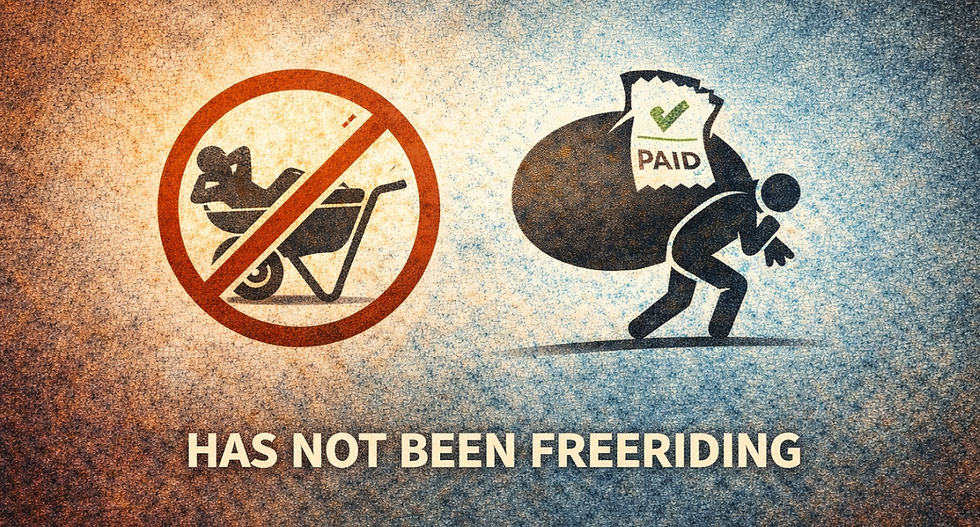
Contrary to Pyotr Kurzin’s framing, Europe’s historical position on defense spending and collective security is not one of chronic shirking or “freeriding” that has unduly burdened the United States. The longstanding U.S. policy toward NATO and European security has been one of partnership in which European nations balanced defense commitments with democratic priorities, social welfare imperatives, and economic stability—not one of irresponsible dependence.
My central argument is that today’s strategic inflection point arises because American policy has been captured, not because Europe failed for decades to invest in its own defense.
I. The Myth of European Freeriding: Context and Clarification
The narrative that European NATO members have “freeridden” on American defense commitments traces back to debates over the alliance’s 2 percent of GDP defense spending benchmark. That target was formalized in 2014 as a guideline, not a unilateral judgment of moral worth or alliance value, and it has since been widely interpreted—and at times misused—as a shorthand critique of European contributions.
Yet the reality is more complex. European defense spending increases have been real and significant over the past decade, especially in the wake of Russia’s renewed aggression against Ukraine, with many member states meeting or exceeding the 2 percent target. As of 2024, 23 of NATO’s 32 member states met the 2 percent guideline, and European defense expenditures collectively increased by roughly 18 percent in recent years.
Europe’s defense posture historically reflected careful strategic calculation: democratic polities with deep social safety nets and civilian priorities have weighed the costs and benefits of military spending in ways distinct from America’s superpower responsibilities.
European nations chose to invest proportionally more in human capital, diplomatic infrastructure, and social cohesion—competencies that also underpin resilient societies and long-term collective security. The reductive “freeriding” trope conflates differences in strategic emphasis with dereliction of duty.
II. U.S. Policy Toward European Security: Partnership, Not Resentment
American administrations across the post-Cold War period regularly pressed Europe to enhance its defense capabilities; this was not a novel Trump administration obsession. From Dwight D. Eisenhower’s warnings in the 1950s about overstretch to Robert Gates’s admonishment in 2011 that European allies needed to do more, U.S. officials have engaged in burden-sharing dialogue for decades. However, these discussions were traditionally framed within the context of alliance solidarity, mutual responsibility, and shared deterrence goals—not as unilateral ultimatums.
The Trump administration’s rhetoric, by contrast, marked a departure not in substance of the broader concern, but in tone, delivery, and transactional framing. Trump repeatedly castigated European allies publicly, linking defense spending to threats and coercive ultimatums, rather than to joint strategic planning and capability development— rhetoric that reshaped perception more than reality.
Even in the context of the Greenland crisis, Trump’s critiques of Europe’s defense contributions were part of a broader confrontational posture that strained transatlantic ties and triggered emergency consultations among EU leaders. European ministers and officials responded not with acquiescence, but with unity around sovereignty principles and allied cohesion. This is what administrations prior would herald as proof of the validity of their policy toward Europe.
III. Europe’s Strategic Calculus and Democratic Imperatives
Europe’s approach to defense spending has been shaped by two interlocking factors that Kurzin’s argument sidesteps:
Democratic and Social Trade-offs: European governments operate in political cultures where defense priorities are balanced against social welfare, economic stability, and public consent. High military spending is not a de facto measure of commitment to peace or deterrence; rather, investment in societal resilience, economic health, and governance legitimacy also strengthens democratic states against both external and internal threats.
Institutional Evolution and Shared Security: The EU’s emerging security architecture—reflected in cooperative initiatives like the Readiness 2030 framework to modernize European defense capabilities—demonstrates that European security integration is advancing on strategic terms that complement, rather than replace, NATO mechanisms. These developments are not evidence of shirking, but of a maturing European security identity.
European policymakers have repeatedly emphasized the need for both NATO unity and autonomous capability development. Recent statements from EU leaders underscore intentions to bolster Arctic security cooperation and invest in regional defense infrastructure, while maintaining respect for allied sovereignty and international law in the face of coercive U.S. tactics around Greenland. These are not the hallmarks of “freeriding,” but rather of calibrated sovereign policy.
IV. The Greenland Episode as Strategic Stress Test, Not Proof of European Failure
The Trump-Greenland episode was remarkable not because Europe “failed” to shoulder burdens historically, but because it revealed how fragile alliances can become when coercion replaces consultation.
European leaders did not capitulate; they refused to yield sovereignty, staged an emergency summit, and publicly reaffirmed allied cohesion even as they criticized the United States’ approach. That reaction underscores not a legacy of dependence, but a commitment to principle and collective security, even under pressure.
Europe’s response to the crisis is further evidence that its defense posture is not simply a reactive byproduct of American dominance, but a developing strategic identity willing to take firm positions on sovereignty and rule-based order. The pushback against Trump’s threats—and Europe’s insistence on alliance mechanisms over coercion—reveals strength, not chronic inadequacy.
V. The Strategic Implications
The proper strategic judgment is this: Europe’s defense trajectory has been shaped by rational democratic choices and evolving institutional frameworks that balanced military capability with broader societal imperatives. The perception of “freeriding” is a rhetorical simplification that obscures the substantive reality of shared strategic burdens. The real crisis is not European underperformance; it is the current American executive’s departure from alliance norms toward coercive bargaining, which has forced Europe into a strategic recalculation.
Europe should invest more in chronic deterrence capabilities and must support Ukraine acutely—but not because it has been a perennial free rider. Rather, these steps are necessary because the alliance now faces an American partner that has weaponized alliance mechanisms against its own members, undermining the very mutual defense ethos that sustained transatlantic security for decades.
The question Europe must address is not “How long did we freeride?” but “Can we now effectively translate the cover America historically provided us into a durable, sovereign defense identity that preserves democratic and anti-authoritarian norms in an era where American policy is unstable?”
The answer to that question will define Europe’s strategic future, not simplistic narratives about past failings.


Comments