


Stop Telling People to Not Protest the Nazi Horseshit Happening in Minnesota
- john raymond
- Jan 16
- 2 min read

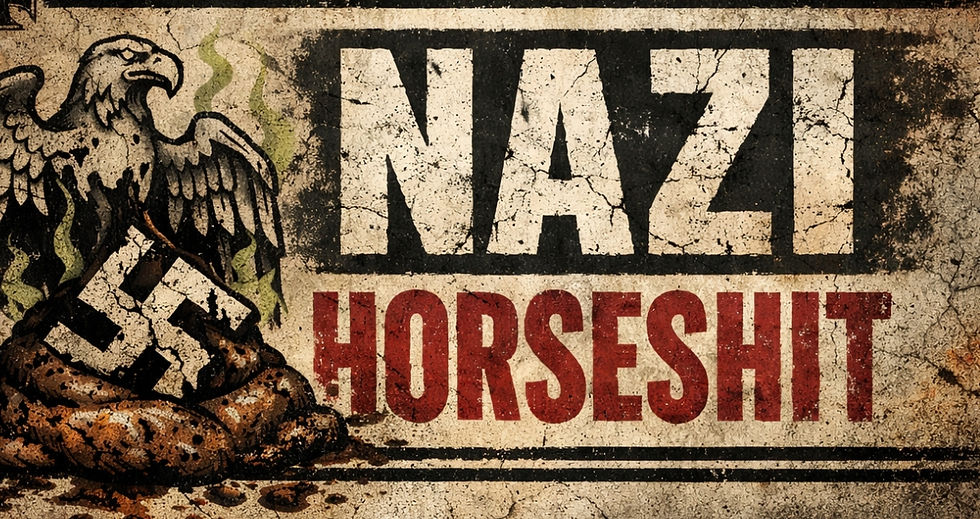
Telling people not to counter-protest a neo-Nazi–style rally in Minnesota is not prudence; it is a surrender of civic responsibility that contradicts the ideology of free speech itself. The argument that counter-protests “risk escalation” or “give President Trump an excuse” collapses under scrutiny. It replaces the duty to exercise rights with a speculative fear of authority—and in doing so, it normalizes the very coercion it claims to avoid.
Freedom of speech in a democratic society is not a spectator sport. It is a reciprocal system: the right to speak includes the right to answer, contradict, denounce, and morally isolate anti-democratic speech in public. Historically, counter-protest has been one of the primary mechanisms by which societies demonstrate that extremist ideologies are marginal, rejected, and socially illegitimate. When the public withdraws “to avoid optics,” extremists gain uncontested space to normalize themselves. Silence is not neutral; it is permissive.
The specific fear being invoked—that visible counter-protests might justify extraordinary executive measures—is also misframed. If an administration wishes to abuse power, it will do so regardless of whether citizens stay home. Conditioning civic action on the hope that an authoritarian-leaning executive will choose restraint is not strategy; it is magical thinking.
The argument for staying home rests on a false premise: that there still exists a low-effort path in which democratic backsliding can be avoided by minimizing friction. That premise is incompatible with history and with political reality. The work required to resist authoritarianism—organizing, protesting, litigating, documenting, voting, and sometimes facing state pressure—does not disappear if one declines to show up on a particular day. It merely accumulates interest.
Worse, the “don’t counter-protest” position externalizes cost. It asks others to accept the moral injury of unopposed hate so that the risk-averse can preserve comfort and plausible deniability. That is why the posture feels lazy: it frames civic labor as optional until the threat becomes undeniable, at which point the price of action is always far higher.
Invoking the possibility that President Trump might deploy force is especially revealing. If the exercise of constitutionally protected counter-speech is enough to trigger military deployment, then the problem is not the protest—it is the abandonment of constitutional norms by the executive. Adjusting citizen behavior to accommodate that abandonment concedes principle in advance.
Democracy does not survive by minimizing effort; it survives by normalizing participation. Counter-protest is not about theatrics or confrontation for its own sake—it is about drawing a clear moral boundary in public space. When citizens in Minnesota are told to stay home while extremists assemble, the message sent is not “de-escalation,” but uncertainty about whether democratic values are still worth the effort required to defend them.
If the work will have to be done regardless—and it will—then postponing it out of fear only strengthens those who rely on intimidation and fatigue. Free speech will not be preserved by self-silencing. It is only preserved by use.


Comments