


Though She Sidestepped the Question, AOC’s Munich Security Conference Performance Proves She Is a Strong Presidential Contender
- john raymond
- Feb 13
- 4 min read

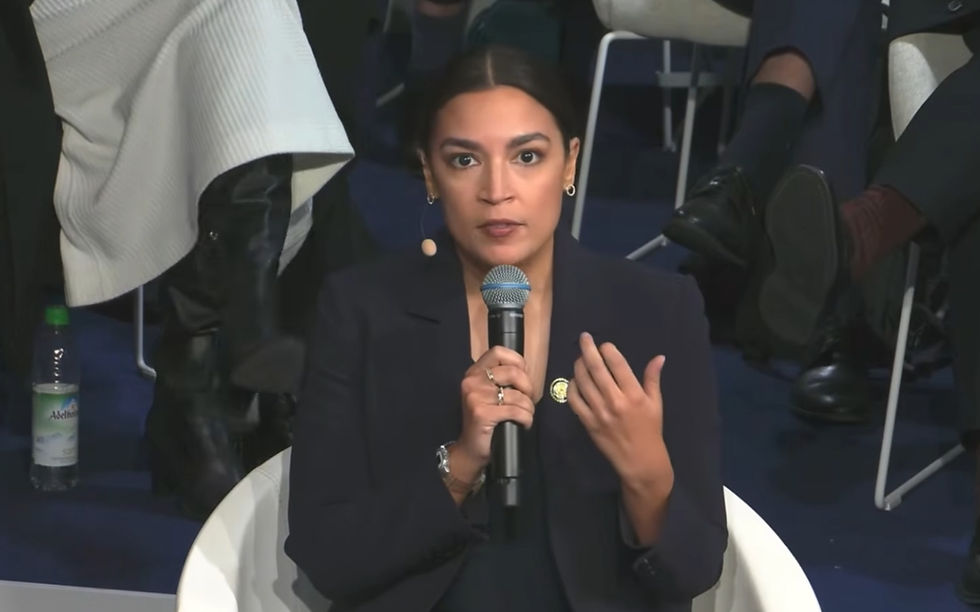
Alexandria Ocasio-Cortez did what serious aspirants to executive power must do before they ever announce: she demonstrated decision-grade foreign policy cognition in a room that measures credibility, not charisma. At the Munich Security Conference on February 13, 2026, she sidestepped the predictable parlor-game question about when she will run for president and instead used each answer to build an integrated argument: democracies lose when they cannot deliver materially for their people, when they allow corporate and oligarchic power to outrun public sovereignty, and when they preach a rules-based order while practicing carve-outs and double standards.
Her sharpest formulation—“hypocrisy is vulnerability”—was not merely moral language. It was a strategic statement about alliance coherence under asymmetric pressure.
The panel began where American political theater always begins: with the implied campaign narrative. She refused to play it. That refusal matters. In international rooms, the first test is not whether an American politician can electrify a base; it is whether they can behave like an institutional actor. By declining to audition for a future race, she implicitly communicated that her presence was about substance, not ambition. That is not coyness. It is discipline.
From there she answered the European defense-spending paradox in the only way that is structurally honest: if European states raise defense spending while cutting social spending, they may inadvertently fertilize the very right-wing populism that authoritarian adversaries exploit. The point is not that defense spending is wrong; it is that defense spending without domestic legitimacy is brittle. When households feel squeezed, when public goods shrink, and when elites ask for sacrifice without visible fairness, resentment becomes a political fuel source. In an era of information warfare, that resentment is not merely an internal problem—it becomes an input to an external adversary’s strategy.
She then widened the aperture to the corporate dimension. Her point, stripped of slogans, is that democracies cannot defend themselves if the economic superstructures inside them behave like transnational sovereigns. When mega-corporations can purchase regulatory outcomes, arbitrage jurisdictions, and out-scale the state’s ability to enforce law, then democratic sovereignty degrades from the inside.
That degradation is not abstract. It expresses itself as cynicism, lower trust, and higher defection rates—citizens, factions, and even allied states begin to doubt whether the system still means what it says.
That is the bridge to her best line: hypocrisy is vulnerability.
This is the sentence that reveals she understands the Byzantine problem in political form. In a world of contested information and malicious actors, coalition maintenance is a consensus problem. Consensus depends on shared predicates—what rules apply, to whom, and when. Hypocrisy corrodes those predicates. It tells allies and neutral states that rule enforcement is selective. It gives adversaries ready-made material for delegitimization. It creates friction at the precise moments when collective action must be fast, aligned, and credible.
This is not moralizing; it is mechanics. A coalition is a network. Networks fail when enough nodes perceive enough other nodes as unreliable. Hypocrisy accelerates that perception. It makes agreement harder, coordination slower, and deterrence less believable. The hypocrite does not merely look bad; the hypocrite functions as a traitor-node in the distributed system, because it raises the coordination cost for everyone else.
With that frame established, she named examples not as scattershot grievances but as evidence of a pattern. She criticized what she described as U.S. actions toward Venezuela in language that cast them as coercive overreach. She pointed to President Trump’s threats toward Greenland as the kind of pressure applied to allies that dissolves trust and normalizes sphere-of-influence thinking. She condemned support for Benjamin Netanyahu without having to explicitly note that the International Criminal Court has issued an arrest warrant for his genocidal behavior in Gaza, treating the contradiction between professed democratic values and selective accountability as an exploitable wound in the rules-based story. Her argument, and rightfully so, is that these contradictions are not side issues—they are strategic liabilities.
Then came her most explicit geopolitical claim: she warned that President Trump and authoritarian counterparts are incentivized to carve the world into geographic domains—an “age of authoritarianisms” in which the Western Hemisphere becomes a personal sandbox for the American executive while Russia intimidates Europe and bullies allied states.
Whether one agrees with her politics is secondary. The structure of the claim is the important thing: spheres-of-influence logic is a direct competitor to rules-based order, and once normalized, it becomes self-reinforcing. If coercion replaces law as the organizing principle, weaker states must bandwagon, bargain, or submit.
When pressed on what commitments should look like beyond NATO, she named the connective tissue that actually makes coalitions resilient: international aid, multilateral compacts, and dense global partnerships. This is where many American politicians become vague. She did not. She treated aid and compacts as strategic infrastructure—tools that bind states together, raise the price of defection, and constrain authoritarian consolidation through networked resistance.
Her entire performance maps cleanly onto the Raymond Method.
Pillar One (Regime Security): her critique presumes that authoritarian-aligned actors prioritize personal power over institutional norms, and that they will gladly degrade alliance integrity if it increases their freedom of action.
Pillar Two (Asymmetric Warfare): her emphasis on legitimacy, hypocrisy, and internal cohesion recognizes that adversaries seek victory by fracturing perception, trust, and consensus—often without needing conventional military dominance.
Pillar Three (Byzantine Traitor-General): her warning about spheres-of-influence politics treats betrayal and coercion not as hypothetical risks but as strategic moves that must be anticipated. Hypocrisy, in this lens, is not a blemish; it is an operational weakness that serves the enemy by undermining agreement.
This is why the sidestep on presidential ambition is, paradoxically, part of the proof. A contender for executive power is not defined by declaring desire; they are defined by demonstrating capacity. On stage, AOC showed she can think like a coalition manager under adversarial conditions: she linked domestic legitimacy to deterrence, linked corporate power to sovereignty, linked hypocrisy to network fragility, and linked spheres-of-influence politics to authoritarian consolidation.
The implication is straightforward. If the presidency is a job defined by crisis management in a Byzantine environment—where information is contested, allies are jittery, and adversaries optimize for your internal fractures—then the relevant question is not “when will she run.”
The relevant question is “can she reason at the level the moment requires.” In Munich, she answered that question with a strong affirmative.
Continue the conversation on bluesky: https://bsky.app/profile/johnrraymond.bsky.social


Comments